Christ The Servant King Church, Community Coffee Morning. Big Brew Quiz. Weds 1st Mar 2023. 10.30 am – 12.00 noon.
Mike King, the Chairman of Wycombe For Fairtrade was asked by the Open Door Community Café coordinator, to run a Big Brew Fairtrade quiz during the middle part of the morning.
There were about 25 people arranged in 6 teams. Mike King as the question master asked a total of 15 questions relating to Fairtrade tea, Fairtrade fashion and clothing, and Fairtrade generally.
The teams had the 15 questions printed on an A4 sheet with three or four possible options.
At the end of the quiz, Mike King then revealed the answers to these Fairtrade questions.
The team with the most correct answers won a Fairtrade selection of chocolate bars. The teams had a very positive and sometimes noisy engagement, but it was all done is a positive and relaxed atmosphere.
Mike King was asked back by the coordinator to do another Fairtrade Quiz around November time, before Christmas 2023.
Tony Thornby, Sheena, and Mike King visited Wayne and Sarah, owners of the RoastLab micro-roastery near Gerrards Cross: RoastLabs are specialists in sole origin coffee using high quality beans, ethically sourced and artisan roasted.
The main purpose of the visit was to taste various sample roasts of green coffee beans previously supplied by CoopeVictoria, a Fairtrade coffee producer located near to the High Wycombe’s Fairtrade partner Town of Grecia, situated in the Central Valley of Costa Rica. The sample green beans had been ordered from the Export Sales Manager at CoopeVictoria just before Christmas. The sample light-medium roasts displayed excellent subtle flavours of caramel and honey, while the darker and more bitter expresso roast had an aroma and taste of dark chocolate.
The RoastLab owners kindly bagged the test run roasted beans for Wycombe Fairtrade steering group members and supporters to sample.
Mike King was able to provide RoastLab with a batch of sample beans from the CoopeVictoria harvest of November 2022 for some further testing. It was agreed by all parties to move on the next stage of providing a single origin Grecia – High Wycombe Fairtrade Towns Partnership Celebration Coffee by late March or early April 2023. RoastLab and Wycombe For Fairtrade agreed on 250g white foil-lined bags with a RoastLab front label indicating the type of coffee, roasting date, aroma and flavour details, and country of origin. Wycombe For Fairtrade in cooperation with Grecia and CoopeVictoria are working on a rear bag label showing images of Grecia and High Wycombe historic buildings and a short description for the reason for producing this coffee.
While awaiting the test roasting results of the 2022 green coffee bean harvest samples, Mike King agreed to progress with the ordering of 2 quintels, 2 x 46 kilos of “Monte Camejo” green beans and investigate the most economic way of transporting and delivering these beans to the UK, either directly from CoopeVictoria in Costa Rica with shipment via air or sea, or indirectly through any mainland Europe importer or wholesaler with recent stocks We would order the necessary amount of green coffee to fill around 200 bags of roasted whole bean or ground coffee. While we want to keep transport and delivery costs to a minimum, Wycombe For Fairtrade will act on the advice of the Export Sales Manager at CoopeVictoria given the late March – early April 2023 deadline for the expected launch of this coffee locally in High Wycombe.
This B2B initiative started by three Fairtrade regions in the UK is now known as the Alternative Coffee Company and the first green beans had arrived in the UK by July 2022 from 5 small-scale Fairtrade coffee producers in Uganda and Rwanda.
The whole growing, supply chain, and selling will ultimately be Fairtrade Certified and link small-scale coffee farmers with independent roasters and cafes, bringing producers and consumers closer together and hopefully improving customer sovereignty and feedback information to all parties. There appear to be some immediate challenges but the trading methodology appears to be sound.
After an excellent lunch on the veranda at the CoopeVictoria Cafeteria, Mike and Sheena King were driven by Marie Angela to Grecia centre where we met Nora Suarez, the Deputy Mayor of Grecia, and Shirley from Grecia Fair Trade Committee, who showed us around the beautiful Roman Catholic Cathedral (Iglesia de la Nuestra Señora de las Mercedes), which is made entirely from sheet steel.
Caption: Sheena, Maria Angela, Shirley, and Nora Suarez in the central aisle looking towards the main entrance.
Caption: Interior of Grecia Cathedral looking towards central altarpiece.
The bright red house of worship was built in the late 19th century out of plates of imported Belgian steel. The separate plates have been plainly riveted together and the whole building painted red. Given the odd make-up of the building, several legends regarding the reasons behind the church’s construction have appeared over the years. One zany theory is that the church, having been imported from Europe, was meant for Greece, but got sent to the slightly similar sounding town of Grecia. Another story says that it was meant for Chile but, due to bureaucratic quicksand, the building simply settled in Grecia. However, the truth behind the building would seem to be the one answer no one wants to believe: that the church was simply purchased by the local government and a group of investors.
Caption: Beautiful Cathedral side chapel altarpiece containing many carvings and statues.
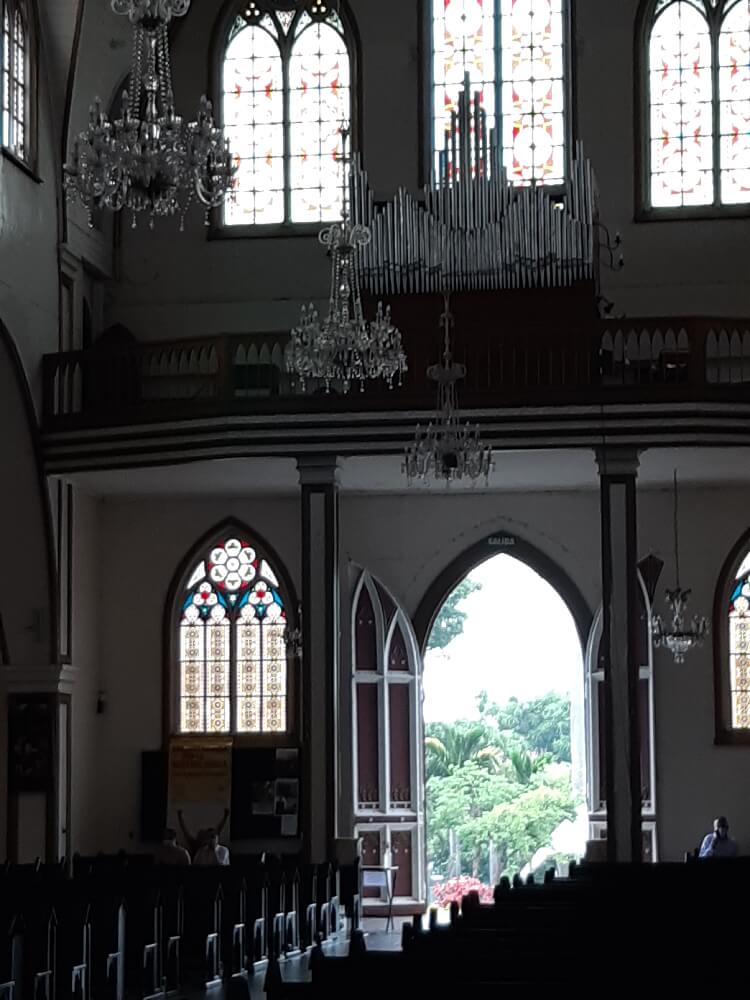
Caption: Looking back to main Cathedral entrance with organ loft and lovely stained-glass windows giving good idea of scale.
The Cathedral is located in the centre of the town in front of the park and a pond. It is the focal point of Grecia and is as imposing as it is impressive. The interior of the Cathedral is just as impressive as the exterior, with beautiful stained-glass windows, icons, and alters with carved figures and statues of the Virgin Mary and Jesus.
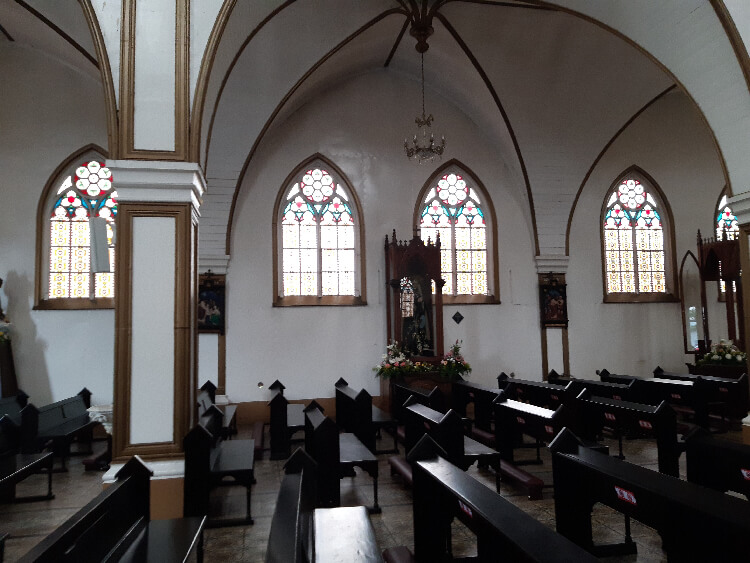
Caption: Grecia Cathedral interior with many carvings, icons and relics devoted to various saints.
Farewells: Municipal Council Chamber and Tour of Grecia Municipal Market
We returned to the Grecia Municipal Council Chamber to say our fond farewells to Nora and Shirley. They gave Mike and Sheena King gifts including a superbly baked cake and a bag of gifts for the Mayor and Deputy Mayor of High Wycombe. Mike was interviewed along with Marie Angela by the local newspaper report and live radio broadcast. After coffee and pastries, we were also shown a couple of videos by the Grecia Municipal Market Manager of the town as well as the historic indoor market.
Indoor Market
Nora, Shirley, Marie Angela, and the Market Manager then gave us an interesting tour of the famous indoor covered market. This had been going for over 100 years and currently was occupied by 94 small, family-run, independent stallholders selling local, homemade products such as food, clothes, shoes, crafts, snacks, and artisanal goods based on local crafts. Large supermarkets and chain stores were banned from this area. There were many interesting murals adorning the tiled walls and passages in the market interior. The local craftsmen and artists had created some inspiring and beautiful depictions of Costa Rican wildlife, animals, birds, forests, and water scenes, as well as depicting historic crafts reflecting the local indigenous culture.
The covered market was open 6 days a week with around 1500 people during weekdays rising to 5,500 visitors on Saturdays. Our impression was of a thriving market providing a good meeting place for the local community as well as offering good quality organic food at reasonable price in the “sopas” (snack bars and mini store).
Day 6 Weds 18th May 2022 Morning – Visit to the FANAL Sugar Cane Distillation Plant
Marie Angela, Greg, and Andres from CoopeVictoria, Sheena, and Mike toured the FANAL sugar cane distillation plant just outside Grecia town, at the invitation of the former Mayor of Grecia, Mainor Molina.
FANAL is a state-owned and managed plant. The plant manager showed us around this interesting and fascinating distillery that extracts methanol from liquid heated from sugar cane liquor, converting it into a range of products, mainly Cacique, a Costa Rican 40% proof rum. Interestingly, Cacique was only allowed to be sold for public consumption within the boarders of Costa Rica only and was not for export.
Caption: FANAL plant. Storage takes containing 2 million liters of sugar cane liquor.
Caption: Heated distilled cane liquour condenses and captured according to alcholol level. 40% proof for Cacique, 90% proof is piped to holding tanks for the health industry.
After the methanol has been extracted by heating the sugar cane alcohol and cooling the steam through heat exchangers, the 94% proof alcohol was diluted down to 40%. Then, the cooled rum goes by a series of pipes to the bottling plant. The remaining industrial strength alcohol was transferred to giant storage tanks awaiting collection by road tankers for transport to processing plants that utilized the 90%+ strength alcohol that was used to make surgical wipes and anti-bacterial hand gels. These gels and wipes were and still are widely used during the global Covid outbreak and in the post Corona virus era.
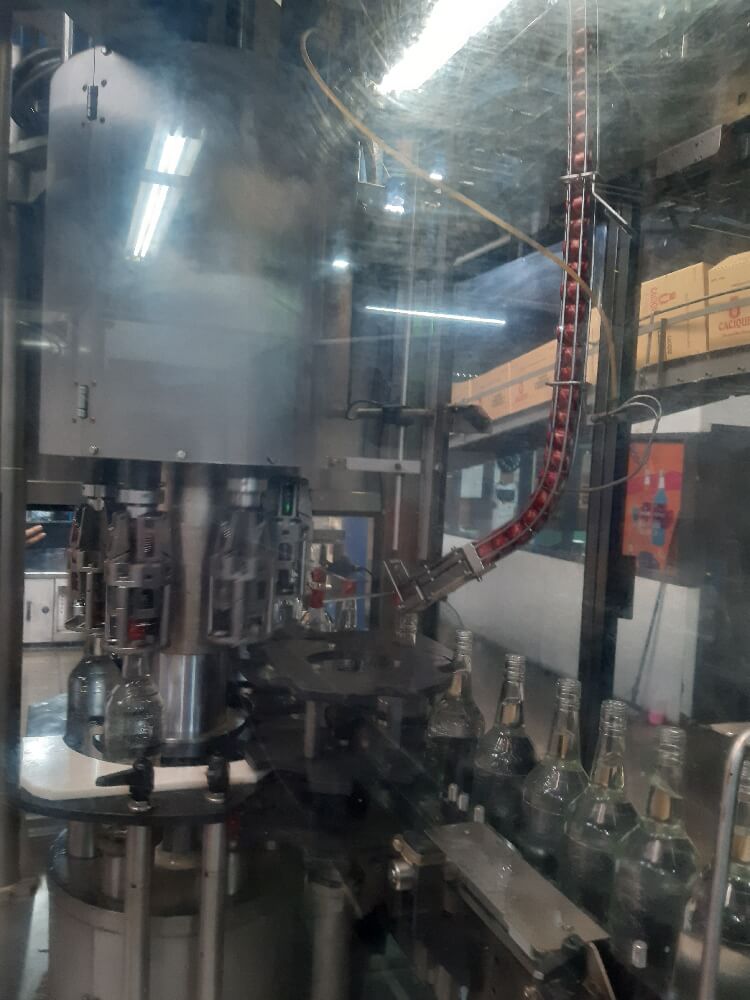
Caption: Bottling plant production line new bottles being filled with Cacique.
Caption: Filled bottles move on to the capping machine for their tops.
We all received gifts of our visit which included bags, baseball caps advertising Cacique, as well as a liter bottle of rum each. Some of CoopeVictoria’s sugar cane was used by FANAL in its processing.
Caption: FANAL plant director with Mainor Molia, a former Mayor of Grecia.
Caption: End of the production line. Bottles are packed 12 to a box for distribution across Costa Rica.
Visit and Tour of the Colegio Experimental Bilingue de Grecia
After an excellent lunch as guests of UNAGUAS, Maria drove us to the Liceo Experimental Bilingue de Grecia, where we were greeted by three final year geography students, Lester, Adrianna, and Viorela, whose command of English and manners were impeccable. They showed us around the whole school, including two ongoing English classes, where Mike was invited to talk to the pupils in English describing life in England and his observations on Costa Rica. So important is English, that the timetable allocates 14 hours per week for each student to learn English, compared to only 4 hours per week for Spanish lessons and 3 hours per week for French! The school seemed very well appointed with classrooms and positive posters and slogans on the walls advocating effort and achievement. There was a bias towards the arts, languages, and social sciences. However, there seemed to be a shortage of computers and a lack of science labs.
Laura Chaves, the Academic Director, also accompanied us around the school. Mike and Sheena were introduced to the school principal, who welcomed us in Spanish and was very complementary about the recent partnership between the Highcrest Academy in High Wycombe where 6th form Geography pupils were having joint Zoom lessons with teachers in Grecia and Highcrest and vice versa. Some of the pupils had establish email “pen pals” with fellow pupils in High Wycombe.
After the tour, we were invited to the staff room where we had drinks and homemade plain and cheese tortillas, as well as gluten and sugar free snacks. Maria even met one of her former English teachers. Mike told the pupils and staff in Spanish what Colette Barker, the Head of Geography at Highcrest Academy, had reported about the benefits to teachers and pupils, of the initial partnership with the Colegio Experimental Bilingue de Grecia. Colette hoped that this liaison would continue through the following academic year. Lester then told us of his positive experiences linking with a pupil from Highcrest Academy who had similar interests to Lester.
There was even time for a photo opportunity with Mike and Sheena King from Wycombe For Fairtrade, Colegio pupils Lester, Adrianna, and Viorela, Maria Angela from CoopeVictoria, Laura Chaves, the Academic Director, and the English Teacher from the Liceo.
We were made to feel extremely welcome at the school. Mike and Sheena King were particularly impressed by the pupils and by the positive learning experiences and encouragement which permeated through the school. Our 2-hour visit seemed to flash by, and it was time to say our “farewells” and express our thanks to our friendly hosts at the Liceo.
Caption: Maria Angela’s photo of Mike and Sheena King with the pupil guides, Lester, Adrianna, and Fiorella to their left. On the extreme left-hand side is Laura Chaves, the Deputy Academic Director at the Liceo and the lead link teacher with Highcrest Academy in High Wycombe. Maria Angela is on the extreme left with an old English teacher.
Visit to UNAGUAS, a Grecia community-owned and managed freshwater supplier, overseeing local sustainability, environmental, and reforestation projects, e.g., tree planting with local primary children.
Introduction
Sheena, Maria Angela, and I were invited by UNAGUAS, theUnion of Grecia Associations for the Environment and Health, to attend and help with a tree replanting morning involving a local primary school class. The purpose of UNAGUAS is to strengthen communal water management in the canton and guarantee to supply fresh and safe drinking water to over 5,500 homes in Grecia and to businesses in the area such as CoopeVictoria for washing coffee beans and processing sugar cane.
Caption: Sheena (far right) and I planted our own native sapling in this new forest gowth. The children loved getting their hands dirty and engaging with nature.
The local community-run project has been operational for 20 years, beginning in September 2002. It is just 1 of 9 community freshwater management systems in the canton of Alejuela. Lydia, the President of the Community Association stated that it was important that “people work together to protect and ensure future water resources”. Their mantra is “Together is Better”
Tree planting, reafforestation, and engagement with children
We joined a local primary school class to plant some indigenous, native species of trees in an area once cleared for logging. The idea was to increase tree cover which holds the soil together, helps retain water, and encourages wildlife like bats and birds to feed on the tree fruits. The trees would provide shade for certain coffee plant varieties in the future. The children also planted saplings which take around 12 years to become established. The benefits are that young children become engaged, get their hands dirty, and learn at the same time, and realize the importance of their natural environment. A professional agronomist ensures that tree saplings are planted correctly.
Caption:School children planting their splings supervised by ecologists and teachers.
Caption: Primary school child finishing planting a sampling.
Caption: Row of recently planted saplings by primary school class.
Future Challenges and Opportunities.
Climate change is starting to have a huge impact in terms of earlier rainy seasons, heavier rainfall, and being near the Eastern Caribbean – frequent hurricanes. Community managed water supply systems are novel, and UNAGUAS are considering running tours for tourists of the water sources, volcanic springs, pumping stations, and storage tanks. International interest is also being shown in their operations from Chile and Mexico who are coming to Grecia to see how these local community run water projects work and share ideas. As this is a voluntary body, people have other jobs outside UNAGUAS. They do however employ full time plumbers, pipe layers, and inspectors.
Caption: Poas volcano provides the run-off water to this stream, the volcanic rock providing a natural filter.
Conservation of Natural Resources and Sustainability
The protection of water resources is vital for communities for which they pay a bit more money to ensure the supply of pure, fresh, naturally filtered water, which is utilized in the commercial sector too, for future generations. Therefore, people are more conscious of water use. Strangely, there are no plugs in wash basins!!! Wherever possible, appropriate and sustainable technologies are utilized.
UNAGUAS link with Grecia Municipality and CoopeVictoria.
UNAGUAS ensures that any new projects are in keeping with nature and the natural environment, keeping heavy industry out of the mountains and the rain catchment areas, while bringing clean water to the people. Water emanates from two local aquafers near to two volcanoes. The volcanic rock is a natural purifier and filter of water. UNAGUAS works closely with both the Grecia Municipality, including the Fairtrade Group and CoopeVictoria. The UNAGUAS logo sits proudly on banners and signs promoting Grecia, CoopeVictoria, and Fairtrade. UNAGUAS shares the Fairtrade development goals, especially the one pertaining to sustainability. Water conservation and protection are issues shared by all three organizations. Marco, the President of UNAGUAS said that he was pleased to be part of the Grecia Fairtrade Town and would continue to work to protect pure water resources, plant more trees to absorb carbon dioxide, so attracting and encouraging wildlife and birds and to increase the biodiversity.
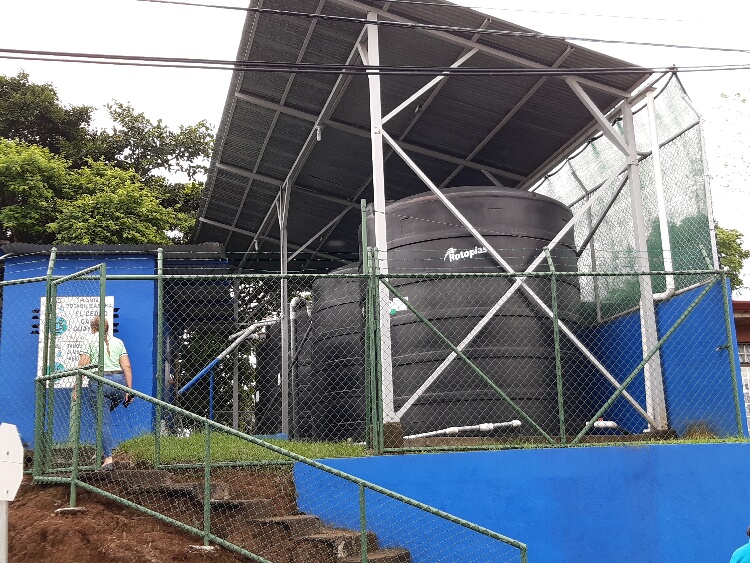
Caption: UNAGUAS water storage tanks at the purification plant in the forest.
Hazel Ordenana Tenacio, the Executive Director of UNAGUAS then gave a speech welcoming Mike and Sheena King to Grecia and thanked them for for visiting UNAGUAS, delivered an interesting powerpoint presentation which Maria translated, and then gave out some welcome gifts to us. A delicious meal then rounded off our visit serenaded by a singer.
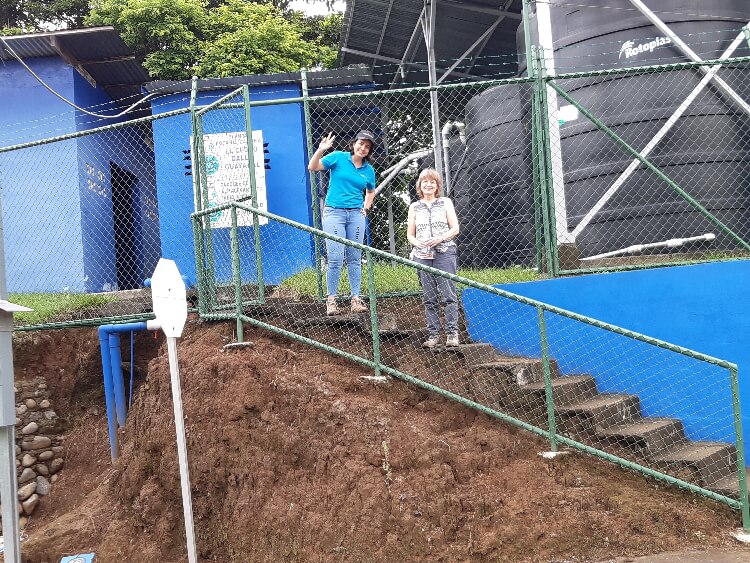
Caption: Maria Angela and Sheena King outside the UNAGUAS water filtration plant where small quantities of chlorine are added to kill off any bacteria.
Day 4. CoopeVictoria – Coffee Quality Testing (cupping) with Mario Chief “Q” Grader. Mon 16th May 2022. Late afternoon. 4.00 pm – 5.00 pm.
The tasting technique is called “coffee cupping” or “cup tasting”. This is how coffee is tasted and tested by producers for buyers around the world to check the quality of a batch of coffee before being exported or sold. In cupping, coffees are scored for aspects such as cleanness, sweetness, acidity, mouthfeel, and aftertaste.
Caption: Migrant coffee pickers accommodation during harvest time.
According to the cupping protocol, hot water is poured directly onto freshly roasted ground beans in the cup and allowed to steep for 3–5 minutes. The infusion is then stirred, and the foamy head removed. The coffee will need to cool before tasting to avoid burning your tongue and to allow the flavours to emerge. Two spoons are used, one going in to the cup and the other into the mouth. Mario, the chief “Quality Grader” at CoopeVictoria, tests every batch of coffee before it is exported to the supplier or wholesaler. He grades many cups of coffee during a workday, so spitting out is a must.
Caption: The coffee quality unit is located in the building where all the CoopeVictoria whole bean and ground coffees are bagged-up in sterile and temperature-controlled conditions.
Caption: Mario, a certified Quality Grader, Marie Angela, and Sheena ready to begin the cupping process.
Marie Angela, Sheena, and Mike were introduced to the protocol that involves smelling the beans or ground coffee for their essence before any hot water is added, then hot water is added and allowed to stand for 4 minutes, smelling the aromas of the hot coffee. The final stage of the process is “slurping” each cup of coffee from a spoon to allow the whole mouth to absorb the taste and flavour. The cupping “scores” the essences, aromas, and flavours present in the coffee, and are then compared to a chart and a score awarded. If the score falls below a certain grade, then the whole batch is dumped. The complex chart indicates the many varieties and flavours of fruit , flowers, and chocolate.
Caption: The Golden Cup plaque for 1st place in the Best Fairtrade Coffee in Costa RIca Competition 2021. CoopeVictoria have won the award three years running.
Just like with wine, one can find endless flavour notes to coffee as each harvest is different. Flavour is directly affected by weather and altitude, but the most important roles are played by the soil and the cultivar.
Caption: 7 of the 8 CoopeVictoria coffee varieties about to be tested for quality. The roaster is just behind Marie and Mario with the extractor fan visible.
Caption: Mario pouring hot water into the 4 coffee bowls relating to the 8 varieties of coffee. Essence, aroma, taste, and sweetness are being tested and scored.
Caption: Two of the 8 CoopeVictoria cofee varieties available in the CoopeVictoria on site shop.
Day 4. Tour of CoopeVictoria Coffee Roastery Mon 16th May 2022. Afternoon.
After a fascinating tour of Carlos’ organic coffee and sugar cane farm, Maria Angela drove us to have lunch in a “sopa”, a small cheap café and mini market with very reasonably priced food. The sopa was owned by CoopeVictoria and sold 8 of their coffees as well as their new range of Rainforest Alliance certificated chocolate bars. The complex included a pharmacy, a few other shops, and a petrol station, the largest in Central America. These were all owned and managed by CoopeVictoria. The petrol and gasoline pumps were powered by solar panels on the roof of the petrol forecourt canopy. After our meal we returned to CoopeVictoria.
Caption: Located in the CoopeVictoria gardens near the roastery are examples of the varieties of coffee plants grown by the small cooperative member farmers.
Andres Gonzales, the Research and Development Director of CoopeVictoria, then showed Mike, Sheena, and Marie Angela around the dormant coffee roastery and explained the processes. The roastery was undergoing mechanical maintenance in preparation for the new coffee harvest in November 2022. Andres pointed out the delivery system for the coffee cherries, the washing process, as well as the coffee cherry mulching machines which removed the pulp to expose the coffee beans. The beans were then dried and either exported as Fair Trade “green beans” for roasting abroad or were roasted onsite.
Caption: Maria Angela and Andres Alvarado pose by the information boards in CoopeVictoria garden relating how sugar cane production has developed since 1943.
The roastery itself dates to 1943 and some of the other equipment like the boilers needed upgrading or replacing. The boilers were currently wood fired and would need to be replaced by less polluting methods.
Caption: Trucks bring the ripe coffee cherries to the CoopeVictoria roastery which are unloaded into these hoppers where the coffee cherries are weighed, and the farmer paid according to weight.
CoopeVictoria produces a range of 8 coffee types grown by the 3000 cooperative small farmers. Six of these coffees have either wholly Fairtrade certification and/or Soil Association certification indicating its organic origin. This included the recently released “Essence of Women” Fairtrade coffee which is grown exclusively by 20 women owned or run coffee fincas (small farms). We saw the bagging ares for the green beans for export in the large warehouse.
Caption: Coffee cherries are then soaked in water in these ponds.
There was a single, non-Fairtrade blend of coffee that was sold entirely within Costa Rica and was not exported. It has proved to be very popular with the Costa Rican public, being widely sold in independent stores and supermarkets, in addition to the CoopeVictoria shop next to the roastery and their “Sopa” located at their petrol station on the outskirts of Grecia. At the conclusion of the tour at 4.00 pm, it was time to visit the “Quality Grading Centre” to test the consistency of the coffee varieties.
Caption: Wet coffee cherries are then turned in these drums to remove the outer pulp layer.
Caption: The pulped cherries are then pumped into these drainage tanks. Water drains out and the mulch is used for free fertilizer by all the CoopeVictoria farmers.
Caption: Boilers are wood fired and have been since 1943. Equipment needs updating and non-fossil fuels utilized.
Caption: Some exported coffees are roasted by CoopeVictoria, others like this new Women Essence coffee are exported as dried green beans and roasted overseas.
Manage Consent
To provide the best experiences, we use technologies like cookies to store and/or access device information. Consenting to these technologies will allow us to process data such as browsing behaviour or unique IDs on this site. Not consenting or withdrawing consent, may adversely affect certain features and functions.
Functional
Always active
The technical storage or access is strictly necessary for the legitimate purpose of enabling the use of a specific service explicitly requested by the subscriber or user, or for the sole purpose of carrying out the transmission of a communication over an electronic communications network.
Preferences
The technical storage or access is necessary for the legitimate purpose of storing preferences that are not requested by the subscriber or user.
Statistics
The technical storage or access that is used exclusively for statistical purposes.The technical storage or access that is used exclusively for anonymous statistical purposes. Without a subpoena, voluntary compliance on the part of your Internet Service Provider, or additional records from a third party, information stored or retrieved for this purpose alone cannot usually be used to identify you.
Marketing
The technical storage or access is required to create user profiles to send advertising, or to track the user on a website or across several websites for similar marketing purposes.