Category Archives: UK News

Standing with the Together Alliance

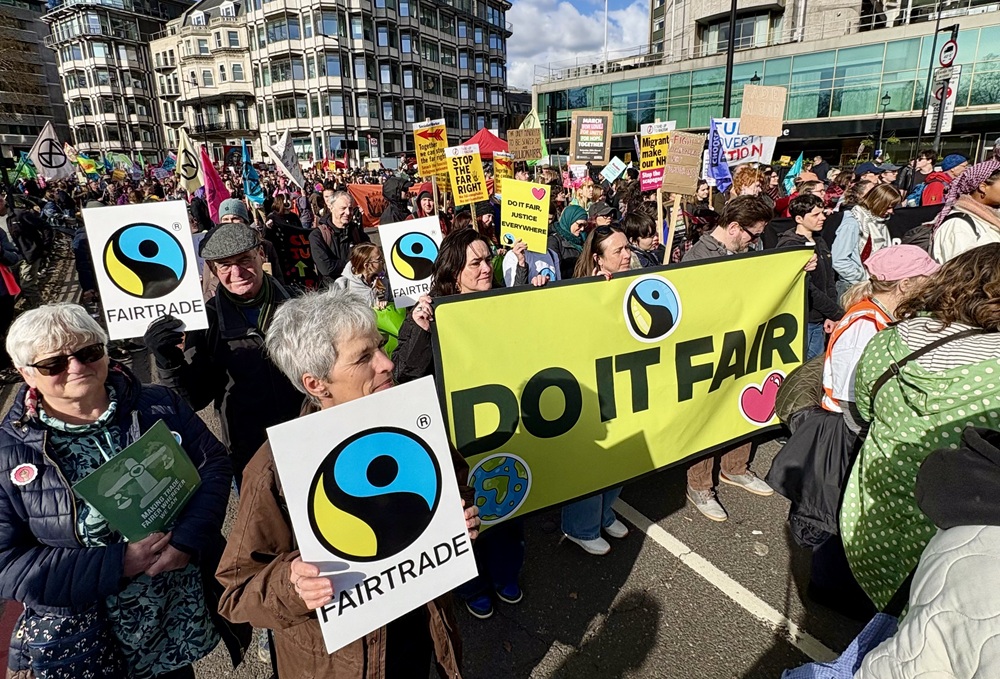
On Saturday 28th April 2026, Fairtrade Foundation joined the Together Alliance and half a million people marching through central London to show that unity is stronger than division.

The Fairtrade Foundation believes in a world that is fair, inclusive and rooted in justice, both here in the UK and for the people across the world that grow the food we rely on every day.

“Before you finish eating breakfast in the morning, you’ve depended on more than half the world.” — Martin Luther King, Jr.

Whether you buy Fairtrade or take part in their campaigns, your support helps create a fairer, more united world. Please add your name to the petition calling on the government to back the people behind our food.

Do it Fair – What “fair” really means

Around the world, the people who grow, pick, stitch and make the things we buy are facing the same challenges: unfair pay, unsafe working conditions, and a climate crisis threatening their livelihoods. Fairtrade exists to change this, and to push for the rules that make fairness the norm, not the exception.

When we listen to producers and farmers, what we hear is clear, fairness breaks down in three key places:

People – rights and safety at work
Planet – protecting the land producers depend on
Pay – earning enough to live well and plan for the future

That’s why our 2026 focus is simple: People. Planet. Pay. Do it Fair.

Demand business that’s fair to people and planet by signing the Fairtrade Foundation petition in as quick as 60 seconds.

What needs to happen now?

The UK government are currently reviewing its approach to responsible business, a rare, once‑in‑a‑decade opportunity to close gaps in the law – and prevent harm before it happens, not after. Farmers and workers can’t afford for this moment to be missed. Help us demand business that’s fair to people and planet. Too often farmers and workers are undercut by businesses that are failing to pay fair wages, protecting workers, and safeguarding the environment. We can change this – stand with producers, farmers and workers around the world.

International Fair Trade Towns Conference 2025 – Edinburgh – Introduction

The International Fair Trade Towns Conference is an event that brings together campaigners, organisations, enterprises and communities from around the world to plan together to strengthen the global fair trade movement. It was attended this year by Wycombe for Fairtrade steering group chairman, Mike King, and its treasurer (his wife), Sheena King.

The theme for the conference this year was Your Town, Our World – Fair Trade Communities & Local Action to achieve the Sustainable Development Goals.

Hosted at The Nucleus Building at the University of Edinburgh’s King’s Buildings Campus, the conference programme is full and aims to meet the following goals:

  • To bring together local and global stakeholders committed to sustainability and wellbeing to highlight Fair Trade’s role in the drive for sustainable development and a new economy
  • To share stories that exemplify local action for global change from local Fair Trade procurement, enterprise, political support and campaigning to global trade justice
  • To platform Fair Trade Nation status as a grassroots campaign that can leverage a local and national commitment to the global goal of fairness, equity and sustainability

Click here for more information on the conference’s programme.

There follows as outline of the event.

Welcome to the International Fair Trade Towns Conference delegates at the Scottish Parliament building on Friday 29 th Aug 2025 by the Scottish Government.

Exterior view of the Scottish Parliament building

Impressive architecture of the Scottish Parliament building at Holyrood.

Mike and Sheena King were among 60 delegates welcomed to Edinburgh by two ScottishMembers of Parliament in the afternoon, Foysol Choudhury SMP, and Sarah Boyack SMP.

They spoke to us in a committee room prior to the tour and were very proud that Scotland has a “Fairtrade Nation” status and that the Scottish government as well as Edinburgh City Council were two of five major sponsors of the Conference. Delegates had opportunities to ask the MPs questions before being taken on the tour of the Parliament building.

Debating Chamber at the Scottish Parliament building in Holyrood, Edinburgh

The light and spacious Scottish Parliament debating chamber.

The semi-circular debating chamber was very impressive and had spaces at the back for
public viewing. Fairtrade is an integral part of the Scottish government’s procurement policy.

Welcome to the International Fair Trade Towns Conference delegates at the Edinburgh City Council Chambers on Friday 29 th Aug 2025 at 6.30 pm by the Depute Lord Provost, Lezley Marion Cameron.

Scottish Piper at the entrance to Edinburgh City Chambers

Scottish piper welcoming delegates to Edinburgh City Chambers with the IFTTC banner in the background

Edinburgh City Hall was a very impressive historic building where we were treated to wine and canapes and prior to the speeches, we were piped in by a woman in full highland dress.

Edinburgh City Council’s commitment to Fairtrade is highly commendable, while there are another 31 local authorities registered as Fairtrade counties, boroughs, towns, etc. who all support sustainable practices, environmental protection, fairness, and endorse the principles
of Fairtrade.

Welcome to the International Fair Trade Towns Conference delegates to Edinburgh City Chambers by the Scottish Fair Trade Conference Chairperson.

Welcome inside Edinburgh City Hall to 18th IFTTC 2025.

18th International Fair Trade Towns Conference – University of Edinburgh 29th August to 1st September 2025. Welcome

Mike and Sheena King attended this excellently organized Conference in Edinburgh in late August 2025. Over 250 delegates, from all over the world, attended the 18 th International Fair Trade Towns Conference in Edinburgh. People travelled from as far away as Japan, Nepal, South Korea, Peru, Bangladesh, and from many countries in Africa. The Conference theme was “Your Town, Our World – Fair Trade communities and Local Action” to achieve the 17 United Nations Development Goals. People began networking straight away.

Tabitha Nyariki, head of Scottish Fair Trade opened the conference, stated that “Human
Dignity” was at the centre of the Fairtrade movement. Bruce Crowther, founder of the Fair Trade Towns movement in Garstang, Lancashire, and the director of the Fig Tree Chocolate Company stated that when people say “you can’t do
that”, he believed that you “SHOULD STEP OUT AND DO IT ANYWAY”!

Group photo of IFTTC Edinburgh Aug2025 delegates at the end of the Conference

The 19th century Guernsey sea captain who helped build Costa Rica

This innovative and entrepreneurial Guernsey sea captain who brought the very first consignment of Costa Rican coffee to St Katherines’ Dock, London in 1864. He is venerated as a hero in Costa Rica for his wide-ranging humanitarian and educational work.

Keep an eye out for news later this year of Wycombe for Fairtrade involvement in some special celebrations on this history.

This 2 minute ITV news video gives an excellent overview:
https://www.itv.com/watch/news/the-19th-century-guernsey-sea-captain-who-helped-build-costa-rica/djkrvx5

‘Do it Fair’ this 2025 Fairtrade Fortnight

2025’s Fairtrade Fortnight will be taking place 22 September – 05 October. Over these fourteen days, we’ll be celebrating the difference we can all make as part of a UK-wide movement calling for a fairer system behind the things we consume every day.

Fairtrade for Wycombe Group selected as Campaigner of the Month

In the December Fairtrade Communities Bulletin published by the Fairtrade Communities Campaigns Team, High Wycombe was selected as campaigner of the month.

The entry was:

Since launching our new online platform in May, over 100 Fairtrade Communities have made a fresh Fairtrade commitment.

Now, we would like to begin celebrating some of the wonderful work that people have been sharing as part of their renewals. Throughout 2024 we will be celebrating campaigners regularly, so keep an eye out on social media and on our emails. 

But to start things off, congratulations to December campaigner of the month, the High Wycombe for Fairtrade group

Through the hard work from Mike King and the rest of the High Wycombe Fairtrade team, great things have been achieved over many years.

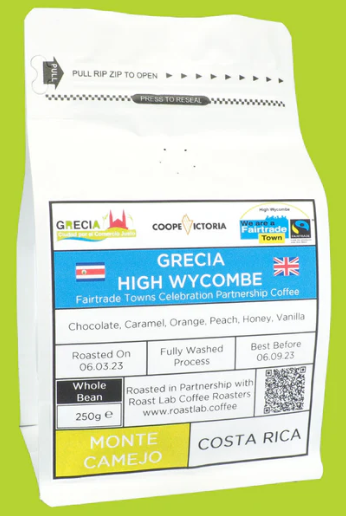
High Wycombe has been a Fairtrade Community for nearly a decade. During Fairtrade Fortnight 2023, Mike King delivered 6 15-minute presentations about the function of Fairtrade to 995 students in the local high school and ran the Celebration Coffee project, built on a long-standing partnership with a Fairtrade Community in Grecia, Costa Rica.

Partnering with the CoopeVictoria Fairtrade coffee producer group, Mike arranged to have their coffee roasted in the UK by a local roaster. This historic moment was part of an ongoing celebration of the partnership between High Wycombe and Grecia’s communities, a partnership fostered by a shared passion for Fairtrade.”

Coope-Victoria-coffee-2023-03

Mike King visit to Horsham Coffee Roasters in Burgess Hill, West Sussex

Exploratory meeting on 13th October 2023 with Bradley and Amelia Steenkamp, owners, and roasters to investigate producing a CoopeVictoria single -origin coffee to mark the first Costa Rican to UK coffee shipment by the Gurnsey sea captain and entrepreneur, William Le Lacheur in the 1840’s.

Background

Horsham Coffee Roaster is an ecologically focused coffee roasting business dedicated to sustainable coffee sourcing direct from small-scale, independent, coffee producers in Central and East Africa, as well as from Central and South America. The state of the art 35-kilo roaster is a hot air roaster giving consistent quality and low carbon emissions. As independent roasters, they pride themselves in having good, long, working relationships with their small-scale farmers and growers.

Direct trade means that they often pay twice the price Fairtrade would pay the farmers, but that depends on quality, type of coffee grown and world prices.  60% of their turnover is from direct sales to clients via their website. They have a large, loyal customer base covering the whole world. 40% is sold through independent farm shops, cafes along the South Coast, and church and community cafes not signed up with another roaster.

Bradley and Amelia’s advice and suggestions on progressing this Le Lacheur (Galleon) coffee project.

Identify potential outlets and calculate possible demand: –

Local Community cafes in area

Local Events  (Pann Mill), Local Shows etc

Church cafes (no leased coffee machine or signed up to a coffee roaster

Farm shops and Garden Centres.

Independent stores

Coop Stores, Budgens, Waitrose may have local autonomy to buy a local sourced or celebration coffee.

Hospitals and Health centres not linked with Costa Coffee or Starbucks.

Opportunities

Advantages could purchase green beans from CoopeVictoria via InterAmerican, a coffee aggregator, facilitator and shipper, for around £7.00 per kilo to the UK and delivered to the warehouse. Although not Fairtrade certified, Bradley has transparency reports going back several years to trace specific batches of coffee.

The price for a roasted blended coffee, labelled and bagged per 250g bag would be around £6.75.

The price for a roasted single -origin coffee, labelled and bagged per 250g bag would be around £7.00. It would be more for fruitier and specialist high-end coffees like Tarrazu, grown in Costa Rica, which would retail around £12.00 to £15.00 per 250g bag.

Perceived Advantages, Disadvantages, and Problems

Advantages

Horsham Coffee Roaster could import sufficient quantities of the Monte Cajeo “green beans” via InterAmerican. (Smallest amount would be around 10 – 12 Kilos enough for 40 or 60 x 250g bags

Imports would be by sea, therefore 60% to 70% cheaper than air freight. These beans would be from the 2023 harvest.

Disadvantages

Horsham Coffee Roaster does not use very big labels, unlike Roast Lab, and in only one case use a second label on the reverse side to tell a story.

Apart from the country of origin, roast type, varietal, flavour notes, and date of roasting, there would not be an opportunity to have an image of William Le Lacheur, or his sailing ship, or indeed any historical background. This was possible with the Roast Lab bags. However, further information about the coffee and the narrative behind this could be included within the Quick Response code on the front of the bag.

Their standard labels do not have images, nor is there much room for one nor any detailed narrative.

Their two blended coffees have a fixed, tried, and tested formula, so this would preclude utilizing the “Lacheur” coffee from CoopeVictoria in these best-selling coffees.

Only one of their ranges of single – origin coffees emanate from producer cooperatives, most come direct from very small – scale, independent farmers.

Problems

Defining the potential market of this “Galleon Coffee” locally, range of retail and community outlets, and judging the quantities required.

Future

Bradley and Amelia are having a family holiday in Costa Rica in 2024 and want to visit the CoopeVictoria Cooperative. They are aware of the quality and reputation of Costa Rican coffee producers.

I have given Maria Angelia Horsham Coffee Roaster email addresses.

Next Steps?

To be decided

Mike King
Wycombe For Fairtrade Friday 13th Oct 2023

The Alternative Coffee Company

This B2B initiative started by three Fairtrade regions in the UK is now known as the Alternative Coffee Company and the first green beans had arrived in the UK by July 2022 from 5 small-scale Fairtrade coffee producers in Uganda and Rwanda.

The whole growing, supply chain, and selling will ultimately be Fairtrade Certified and link small-scale coffee farmers with independent roasters and cafes, bringing producers and consumers closer together and hopefully improving customer sovereignty and feedback information to all parties. There appear to be some immediate challenges but the trading methodology appears to be sound.

Steering Group Members invited to Costa Rica Orchard Festival 9th February 2022 at the Royal Botanical Gardens, Kew

Steering Group Chairman, Mike King, and Group Member Jhon Munoz were invited by the Ambassador of Costa Rica to the UK to the official opening of the Costa Rican Orchid Festival month.  The orchids, some of the 1600 that  were native to Coast Rica, were stunning. It was a chance to renew our acquaintance with Ambassador Ortiz as well as brief him on our future activities with Grecia and CoopeVictoria.


FAIRTRADE AND CLIMATE JUSTICE – Key Facts from the Fairtrade Foundation

Note; This is a reprint of information available on the Fairtrade Foundation website as a PDF.

In 2022 we are continuing to highlight the growing challenges that climate change brings to farmers and workers in the communities Fairtrade works with as COP26 didn’t deliver the change needed to tackle the climate crisis.

The facts are straightforward. Farmers and workers in countries such as Kenya, Ethiopia and Honduras, who have done the least to contribute to climate change, are disproportionately affected by it. The climate crisis is the biggest threat to the livelihoods of millions of small-scale farmers and agricultural workers in low-income countries worldwide.

The COVID-19 pandemic has shown us more than ever how interconnected we are globally. This interconnection is at the very heart of the Fairtrade message and is where your role begins. Farmers need better incomes and financial support to adapt to changing weather patterns and change their farming methods to ensure a low-carbon economy. By choosing Fairtrade, you show solidarity with those on the frontline of the climate crisis. You are part of the Fairtrade movement, and you havethe power to drive long-term change, not only with your shopping choices but with your support in spreading the message.

THE PROBLEM

For generations, the exploitation of people and planet has caused extreme global inequality and a climate emergency. Fairtrade farmers have told us that climate change is their biggest challenge right now.

They are bearing the brunt of the climate crisis in the most climate vulnerable nations. Despite contributing the least to the climate crisis, smallholders in developing countries are disproportionately affected by increasingly frequent weather events, loss of fertile soil and crop diseases. The farmers that Fairtrade works with have seen their crops of coffee, cocoa, honey, and vegetables in Honduras, Guatemala and Nicaragua be completely devastated. At 1.1 degrees, current levels of global heating are causing communities to suffer hurricanes in Central America, floods and landslides in India, sweeping away people’s homes, destroying entire livelihoods in seconds, while swarms of locusts affect East Africa and extreme drought continues in Southern Africa. By 2050 as much as 50 percentof the global surface area currently used for coffee farming may no longer be suitable and many cocoa growing regions in Ghana and Côte d’Ivoire – who produce over half of the world’s cocoa – will become too hot to grow the crop.

Farmers have fewer resources to adapt to changes in climate and other stresses they are experiencing every day. Yet we all rely on farmers to produce the food we need for a growing global population. 80 percent of the world’s food comes from 500 million family farms. With the continuing global COVID-19 pandemic, these communities also face rising debts, falling commodity prices and widespread shocks in the global supply chains. These huge challenges, alongside already low incomes, mean these communities are often unable to invest in ways to adapt to the widespread effects of a changing climate, let alone clean energy and climate-smart farming methods needed to protect the planet’s forests and help restore biodiversity.

SUMMARY: Climate change is an immediate threat to farmers’ livelihoods, and to the products we love, like chocolate, coffee and bananas. Unless we clamp down hard on global emissions, we will all suffer. As a matter of justice and a matter of science, the matter of the climate crisis cannot be delayed any longer.

WHAT NEEDS TO HAPPEN?

The answers to climate change exist already and farmers have a big role to play. Farmers have years of experience stewarding the land they live on; farming communities in climate-vulnerable countries already have the knowledge to create solutions and to protect the ecosystems everybody relies on. What they don’t have is the financial support to make those changes happen. Climate finance and compensation for loss and damage must reach the communities most impacted by climate change who also hold solutions to farm us away from climate catastrophe.

Doing this properly means helping farmers and workers to adapt to the current impacts as well as supporting them to switch to low carbon production and transport. That cannot happen if we’re not prepared to pay for it. We cannot expect – and it is not fair to expect – farmers to absorb the costs of more sustainable methods of farming when they’re often not even able to earn a living income or living wage and cannot even adapt to the challenges they are already seeing, because the price they receive for their produce is far too low. This needs to change – and it needs to change fast. Change by 2050 is too late. The weather is changing now.

Our global trading system is balanced in favour of the powerful few. Wealthy nations have done the most to create the climate crisis. They must deliver on their promise to invest in tackling climate change right now. The G7 summit in June 2021 was a missed opportunity for farmers and the planet.

Political leaders at COP26, despite some new pledges to curb emissions which revise projected temperature rises from 3.0 to 2.4 degrees, were also unable to commit to realistic targets to keep them to 1.5 degrees. Commitments to compensate impacted communities for loss and damage due to extreme weather were also notable in their absence from the final agreement.

At the same time, the prices that businesses pay for the crops behind some of our favourite foods need to increase significantly if farmers are to escape poverty and still have the means to adapt to economic and environmental shocks. Governments must set ambitious, science-based rules and targets that will ensure that the businesses who profit the most from global trade invest in reducing their carbon footprint, and support those experiencing the harshest effects right now. We needbusinesses to go further in committing to fair pricing, long-term partnerships and investment in adaptation with farming communities as well as transparency on carbon emissions and climate risks throughout their supply chains. As global trade changes in ways we could only have imagined before the pandemic, poverty will also continue to be a key contributor to further environmental degradation as farmers are forced to make harder choices.

SUMMARY: Farmers in climate vulnerable countries need empowerment, fair value, fair prices, and fairer trading practices to resource the investment needed for mitigation, adaptation, diversification and resilience in the face of the climate crisis. And we can’t rely on global summits and governments to take action fast enough to solve the climate crisis. Ahead of COP27, we must build pressure on governments to keep 1.5 alive. By doing so, we stand in solidarity with people in climate vulnerable nations who will be most impacted by temperature rises.

HOW DOES CHOOSING FARTRADE SUPPORT FARMERS FACING THE CLIMATE CRISIS NOW?

Fairtrade is about social justice. Poverty, caused in part by decades of chronic underpayment, is a root cause of inability to adapt and mitigate to climate change. Poverty prevents smallholder farmersfrom developing their businesses: this fuels a vicious cycle of low productivity and declining incomes. The less farmers earn, the harder it is to secure good harvests. All this leaves them financially unable

to face up to the challenges of climate change. Choosing Fairtrade means choosing improvements in farmers’ livelihoods with collective strength through co-ops and their bargaining power, the protection of a minimum price and Fairtrade Premiums. More money means more climate resilience into the future.

While the money paid to farmers remains low, they will continue to struggle to cover just their basic human rights; a nutritious diet, their children’s education and family healthcare, let alone find extra funds to pursue climate friendly farming, or to protect themselves and their harvests from extreme weather. In 2019, Fairtrade launched an ambitious new living incomes campaign to lead the way to a sustainable future for cocoa farmers. A living income would provide farmers with a decent standard of living – enough to cover all their cocoa farming costs and enough to cover their basic human rights.

Fairtrade works on many levels to strengthen environmental and climate protection for farmers and workers and is committed to finding new ways to support them with the challenges of climate change. Governments can do much more to incentivise businesses to support farmers with finance, fair prices and other assistance to adapt. The exploitative global trade system continues to give disproportionate power to wealthy nations. It’s time for our politicians to recognise their responsibilities and ensure the investment reaches these communities so that they can deliver the solutions. Fairtrade farmers are already implementing projects on climate change. They are learningto adapt, mitigate and become more resilient, working with specific groups, like youth and women and creating sustainable solutions to the climate crisis. But this can only be sustained and increased by working in partnership with them so that they can invest in the projects, training and technology they need. This is why Fairtrade is engaged at political level and in alliances together with other civil society players for more environmental and climate protection. Politicians must listen to and respect farmers’ expertise, needs and ambitions. The people who produce our food and goods seethe reality of the climate crisis every day – they must take a leading role in deciding how any investment is spent.

SUMMARY: Our trading system is weighted against low-income farmers. The prices paid for the crops behind some of our favourite foods need to increase significantly in order for farmers to escape the cycle of poverty and still have the means to adapt climate emergencies. Now more than ever, they need fair pay, fair prices and fairer trading practices.

WHAT CAN YOU DO?

  • Choosing Fairtrade is one simple decision UK shoppers and businesses can make to stand with farmers and workers on the frontline of the climate crisis. Fairtrade works with farmers to strengthen environmental and climate protection, to provide resources, training and knowledge so they can face climate challenges right now.
  • It’s up to all of us – citizens, farmers, workers, businesses, and civil society organisations to come together to play our part in cutting emissions and build pressure for climate promises to be delivered at COP27 next year. Join us in Fairtrade Fortnight 2022 to show support for those who depend on the land – farmers, workers, miners – and join their outraged voices, by sharing their concerns and campaigning to achieve the change we want to see for the planet. Fairtrade Fortnight 2022’s Choose the World you Want festival, will continue to amplify the voices of farmers and workers, the steps they are already taking to fight the climate crisis, and highlight the role of businesses, shoppers, governments and citizens in supporting them to win the fairer future that we all know they deserve.

SUMMARY: Choose Fairtrade this Fairtrade Fortnight and beyond; choose to fight for climate justice, for farmers on the front line of climate change, for our planet and for future generations. Choose the world you w